 |
| thanks wikipaintings.org {public domain} |

About Me

- curator
- Oregon, United States
- loves: you win if you guessed "pets" and "museums". Also books, art history, travel, British punk, Korean kimchi, bindis, martinis, and other things TBD. I will always make it very clear if a post is sponsored in any way. Drop me a line at thepetmuseum AT gmail.com !
Thursday, January 31, 2013
valadon paints as a cat studies

Wednesday, January 30, 2013
the romantic tomcat: e.t.a. hoffmann's "kater murr"
"Is it such a great thing to walk upright on two feet that the species calling itself Mankind should claim dominion over all of us who go about, better balanced, on four?" So asks the cat hero of the German Romantic writer E.T.A. Hoffmann's last great novel, The Life and Opinions of the Tomcat Murr (originally published in Germany over the years 1819-1821).
Full disclosure: I haven't read this book yet, as I was introduced to it only last weekend and it's 384 pages (and I promised someone I'd read The Master and Margarita first). But it is considered to be perhaps the first "postmodern" novel in its experimental approach, wildly inventive and full of left-handed observations on art and society.
Murr, a sapient tomcat, has written his life's story and hasn't a scrap of modesty false or otherwise in the product - but supposedly a mixup at the printer's interleaves his book with the autobiography of the gifted but darker musician Kreisler. Get a glimpse of this tale with the "Look inside!" feature at Amazon. A web search will bring up all kinds of notes and thoughts on this novel, but maybe you'll like this one. And you must see the glorious original title page!
Full disclosure: I haven't read this book yet, as I was introduced to it only last weekend and it's 384 pages (and I promised someone I'd read The Master and Margarita first). But it is considered to be perhaps the first "postmodern" novel in its experimental approach, wildly inventive and full of left-handed observations on art and society.
Murr, a sapient tomcat, has written his life's story and hasn't a scrap of modesty false or otherwise in the product - but supposedly a mixup at the printer's interleaves his book with the autobiography of the gifted but darker musician Kreisler. Get a glimpse of this tale with the "Look inside!" feature at Amazon. A web search will bring up all kinds of notes and thoughts on this novel, but maybe you'll like this one. And you must see the glorious original title page!
Tuesday, January 29, 2013
"my carroty cat" - in praise of orange
A poem from an 1875 anthology, in which the poet's eyes are opened to the sheer glory of an orange kitten. I can't believe it would take anyone six stanzas to do so - but enjoy.
MY CARROTY CAT
Might I not dye it for charity's sake?
Tabby and tortoiseshell, ebon and white,
All are so pretty, while this is a fright!
How shall I play with it, praise it or pat?
What can I do with a carroty cat?
Golden and auburn, and chestnut and fair,
Brown, black, and white, are the colours for hair;
All have admirers, but nothing is said,
Since hair was hair, for a carroty head!
Kittens are judged by the same rule as that—
I'd be ashamed of a carroty cat!
Why, it's chasing its tail, I declare!
Leaping with delicate joy in the air!
Purring and frisking with light-hearted mew
Just like a cat of respectable hue!
Making a bright little heap on the mat—
Must it grow into a carroty cat?
If it is innocent, happy, and kind,
Ought we its carroty colour to mind?
I should be quite in a mess, I suppose,
If people sneered at a freckly nose!
Let me remember the rule, tit for tat,
Ere I condemn a poor carroty cat!
Look at its snug little kitteny face!
Every movement a movement of grace;
See it embracing my hands and my feet,
Playfully tender, engagingly sweet;
Round little feather-ball, fluffy and fat—
Am I admiring a carroty cat?
Yes, let me honestly own how it is—
Never a kitten was nicer than this!
Safe from the least interference from me,
True to its colours the darling shall be—
White as a snowdrift or black as a hat,
None can compare with my carroty cat!
Leaping with delicate joy in the air!
Purring and frisking with light-hearted mew
Just like a cat of respectable hue!
Making a bright little heap on the mat—
Must it grow into a carroty cat?
If it is innocent, happy, and kind,
Ought we its carroty colour to mind?
I should be quite in a mess, I suppose,
If people sneered at a freckly nose!
Let me remember the rule, tit for tat,
Ere I condemn a poor carroty cat!
Look at its snug little kitteny face!
Every movement a movement of grace;
See it embracing my hands and my feet,
Playfully tender, engagingly sweet;
Round little feather-ball, fluffy and fat—
Am I admiring a carroty cat?
Yes, let me honestly own how it is—
Never a kitten was nicer than this!
Safe from the least interference from me,
True to its colours the darling shall be—
White as a snowdrift or black as a hat,
None can compare with my carroty cat!
From Hymns and Poems for Little Folks (anon., Cassell Petter & Galpin, 1875) p. 262-3.
Monday, January 28, 2013
sergeant stubby
 |
| thanks wikipedia (PD) |
In the spring of 1917 the 102nd Infantry, 26th (Yankee) Division was drilling at Yale Field in New Haven, CT. A bull terrier mix puppy began to show up, from where no one ever knew, and join in the drills. Over time he was named "Stubby," became particular friends with Corporal Robert Conroy, and when it came time for the division to go to war, Conroy smuggled the pup on board the troop ship. So began what really was a glorious life of battle and service. Stubby was wounded in battle, healed up and went back out to the front. He captured a German spy (by biting his rump and not letting go). He wasn't just called "Sergeant," he was promoted. He earned a string of awards and medals as long as his leg. Then, after the war, he attended law school at Georgetown with Conroy and became the mascot for the Georgetown Hoyas.
There is much more to know about this dog, who did more in his life than many humans. Rather than repeat it all here, I will send you to these good sources:
Here's Stubby himself, stuffed at the Smithsonian
He was the Badass of the Week once (warning, swearing there, but I loved this article and he deserves to be a Badass)
He even made it to McSweeney's.
Geez, I feel underaccomplished now.
Sunday, January 27, 2013
a patient dog and a fishing pole: forain's "the fisherman"
 |
| thanks wikimedia commons (PD) |
Would you think this had been done by a master of Parisian society scenes? The Impressionist Jean-Louis Forain (French, 1852-1931) was best known for realist portrayals of people enjoying themselves in the city, dressed up (or undressed), drinking, partying, performing. And then there's this, a quiet empty periwinkle dawn with the clouds' reflections stirring about on the water, and a dog happy to sit and be. I get the feeling Forain painted this as a break from the usual fare of lights, crowds and voices, celebrating an entirely different sort of companionship.
Friday, January 25, 2013
dandie dinmont oldstyle
 |
| thanks wikimedia commons (PD:100) |
Thursday, January 24, 2013
a tamed buzzard
A child growing up motherless in the 19th c. looks for companionship from all manner of creatures, including a bird of prey:
My first strange pet—I mean foreign to the household—was a buzzard, a large and noble bird which I used to carry about on my arm or shoulder when I was about seven years old. I called him Nestor, he looked so grave and wise ; and though I loved him very much, or thought I did, and took him often into the fields to spend my time with him alone, I always regarded him with a certain kind of awe, especially when he stretched out his great brown wings, and closed them over his head, as he always did in the act of eating, holding the food in his claws, and devouring it beneath this natural veil, as if the act of eating was too sacred and important to be exposed to vulgar eyes. I do not think my venerated friend was very amiable, or cared much about the laceration of the small arm on which he was carried, and which often bore the marks of his powerful talons.
My first strange pet—I mean foreign to the household—was a buzzard, a large and noble bird which I used to carry about on my arm or shoulder when I was about seven years old. I called him Nestor, he looked so grave and wise ; and though I loved him very much, or thought I did, and took him often into the fields to spend my time with him alone, I always regarded him with a certain kind of awe, especially when he stretched out his great brown wings, and closed them over his head, as he always did in the act of eating, holding the food in his claws, and devouring it beneath this natural veil, as if the act of eating was too sacred and important to be exposed to vulgar eyes. I do not think my venerated friend was very amiable, or cared much about the laceration of the small arm on which he was carried, and which often bore the marks of his powerful talons.
Nor am I sure that I was myself quite clear of blame in exciting his savage propensities ; for I remember a terribly wounded leg of his, the consequence of my chasing an old woman in the harvest field with the great bird held out in my arms, his beak and claws very formidably presented to the old woman, who turned sharply round and struck him with her sickle, to my indignation and dismay; though feeling that I could say little in the way of complaint. Of course the wounded warrior was carefully attended to, and soon recovered from the blow.
From "Our Pets," by "S.S." Published in Once a Week: An Illustrated Miscellany of Literature, Art, Science ..., S. Lucas, ed. Volume 2 (December - June, 1860; London: Bradbury & Evans), p. 16.
Wednesday, January 23, 2013
a prickly hedgehog to guard your book
 |
| thanks wikimedia commons (PD) |
Tuesday, January 22, 2013
different takes on cat & dog superstitions
A black cat crossing your path is a sure sign of bad luck . . . or is it? The same study on superstition that brought us "Judy and the Cats" a few days ago also has lists of these beliefs that I haven't heard before. Here's some:
- If a strange yellow cat comes to your house, it will bring good luck
- If a gray cat follows you, it will bring you good luck
- If a black cat comes to your house, all the girls in the family will be old maids
- If a cat runs across the path of a young couple, it means that they will be married some day
- It is bad luck to take the cat when you move, unless you wave it at some one of your friends when you start (Needless to say, this is an old belief and completely wrong -- curator)
- If you will carry a black cat three times around the house on the first black night after New Year's eve, it will insure you good luck all the year
- If you notice which direction a cat's tail points, when she washes her face, it will tell you the direction the wind will blow
- Any person who despises cats will be carried to his grave in a howling storm
- If a white dog follows you before breakfast, you will meet with some misfortune or be disappointed in some way in the near future
- If a dog has its picture taken, it will be sure to die (That's clearly an old belief too - people didn't take many photos of their dogs in 1907, I imagine -- curator)
- If a dog howls with his nose up, it is a sign of fire
And last but not least
If a black cat crosses your path, your wish will come true Fletcher Bascom Dresslar, Superstition and Education (University of California Publications vol. 5 no. 1, 1907), passim.
Monday, January 21, 2013
a new maneki neko from miss ella
 |
| image copyright and by kindest permission of e. goodwin |
"My background is in costume making and animation," Ella tells me,
I went on to focus on illustration and design but continued to make all of my own clothes for years. I had my fingers in so many pies but could never decide which path to fully follow as I loved every single pie! I realised that I didn't have to stop anything but could incorporate them all in one place in my shop on Etsy.
So my shop includes illustration, jewellery, toys and dresses too. There is quite a feline theme within the shop as one is inspired by these independent creatures particularly the ones I love the most; Chewbacca and Tiger, my two long haired baggy pantalooned and super fluffy moggies!
She's on Etsy at ShopMissElla, where you can be tempted many times over. Also be sure to look at her portfolio at ellagoodwin.co.uk and scroll a bit through her blog.
Sunday, January 20, 2013

Saturday, January 19, 2013
judy and the cats, part 2
Continued from yesterday's post!
Then the black cat spoke at last:
Then the black cat spoke at last:
'Judy, agrah, don't stay up so late again, for the fairies want to hold a council here tonight, and to have some supper, but you have prevented them: so they were very angry and determined to kill you, and only for myself and two daughters here you would be dead by this time. So take my advice, don't interfere with the fairy hours again, for the night is theirs, and they hate to look on the face of a mortal when they are out for pleasure or business. So I ran on to tell you, and now give me a drink of milk.'
And after the milk was finished, the cat stood up and called her daughters to come away. 'Goodnight, Judy, agrah,' she said. 'You have been very civil to me, and I'll not forget it to you. Good-night, good-night!' With that the black cat and the two kittens whisked up the chimney: but Judy, looking down, saw something glittering on the hearth, and taking it up, she found it was a piece of silver, more than she could make in a month by her spinning, and she was glad in her heart and never again sat up so late to interfere with the fairy hours, but the black cat and her daughters came no more again to the house.
--Fletcher Bascom Dresslar, Superstition and Education (University of California Publications vol. 5 no. 1, 1907) p. 155-6.
--Fletcher Bascom Dresslar, Superstition and Education (University of California Publications vol. 5 no. 1, 1907) p. 155-6.
Friday, January 18, 2013
a folktale: judy and the cats, part 1
From a University of California publication on superstitions, 1907:
The heart of Judy was touched, for she thought it was some small child that had lost its way, and she rose up from her spinning, and went and opened the door—when in walked a large black cat with a white breast, and two white kittens after her. They all made over to the fire and began to warm and dry themselves, purring all the time very loudly; but Judy never said a word, only went on spinning.
Then the black cat spoke at last:
--- Visit tomorrow to hear what she had to say!
--- Visit tomorrow to hear what she had to say!
--Fletcher Bascom Dresslar, Superstition and Education (University of California Publications vol. 5 no. 1, 1907) p. 155-6.
Thursday, January 17, 2013
some thoughts on the ancient egyptian cat
In A Handbook of Egyptian Religion by Adolf Erman (London, 1907), I find some ideas on the cat in ancient Egyptian theology that are pleasingly different from those I usually see:
There is another great goddess of the Delta to whom it is natural to assign a similar origin; Bast, or as the Greeks called her, Bubastis, is a counterpart of the joyous Hathor, delighting in dancing and music. She is cat-headed, and is usually represented with the sistrum of the dancing women in her hand and a basket on her arm. (p. 13)
Wednesday, January 16, 2013
a (mostly) wordless wednesday

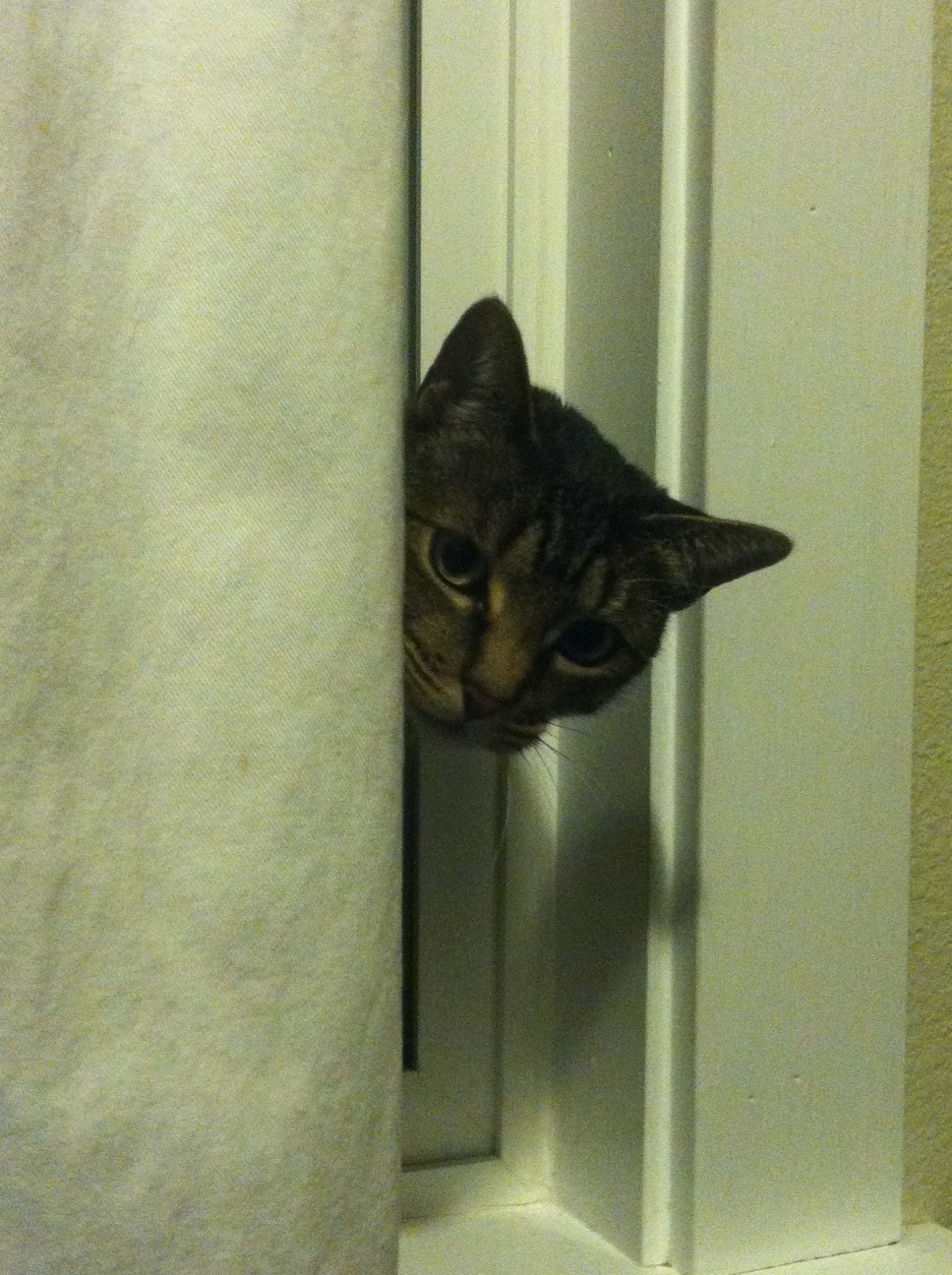
New photos from last weekend. Above, Kat Von D snuggles, one of her favorite things.
Below, Elizabeth sleeps in her favorite thing: a box we got for something around Christmas, and now we clearly will never be able to get rid of it.

Below, the Kat is ready for her close-up.

Elizabeth is not.
Thank you for visiting!
Tuesday, January 15, 2013
henri III's basket of puppies
Another diverting anecdote from The Recreative Review, this time found in Vol. III (p. 559, and original spelling kept):
Would you like to read more about this entertaining, but ultimately tragic prince? You can start with Wikipedia, but here's a good article from History Today.
Monday, January 14, 2013
on the suckling of dogs in naples
Suckling Dogs.—" If the Neapolitans bury Protestant Christians like dogs, they make some singular compensations, we will confess, by nursing dogs like Christians. A very veracious man informed me yesterday, that his poor wife was half broken-hearted, at hearing such a.countess's dog was run over. 'For, (said he,) having suckled the pretty creature herself, she loved it like one of her children.' 1 bid him repeat the circumstance, that no mistake might be made: he did so; but seeing me look shocked, or ashamed, or something he did not like: 'Why, madam,' said the fellow, 'it is a common thing enough for ordinary men's wives to suckle the lap-dogs of ladies of quality:' adding, that they were paid for their milk, and he saw no harm in gratifying one's superiors. As I was disposed to see nothing but harm in disputing with such a competitor, our conference finished soon;but the fact is certain." (Piozzi's Tour, vol. ii. p. 57.)
--Excerpted in The Recreative review, or Eccentricities of Literature and Life, vol. 2 (London: J. Wallis, 1822), p. 518. As to the comment about burying "Protestant Christians like dogs," this opinion betrays some British prejudice of the time, obviously, and is illuminated on p. 264:
"Funereal rites have from time immemorial occupied the attention of mankind ; and this reminds us of the remark which foreigners make of the English, that all they think about, is that of being buried decently. There is some truth in it; but that luxury is denied to us abroad, particularly in Italy, where our heretical bones must not pollute those of catholics, (us Christians, as they call themselves,) but within twentyfour hours after a protestant's death, he is shovelled into a hole like a dog. Those, therefore, who travel, should make their last stage at Leghorn, where we have a churchyard of our own, and are not treated like brutes, after having spent our money among them like princes."
Sunday, January 13, 2013
vintage photo time
 |
| thanks ampersand bulk bin |
Saturday, January 12, 2013
spell "mousetrap" with 3 letters
. . . C-A-T.
Okay, you knew that one. I'm on a riddle roll this morning, so try these out! Answers in the tiny print at bottom.
1. What's the difference between a cat and a book?
2. Why does a dog wear more clothes in summer than in winter?
3. A certain room has eight corners; in every corner sits a cat, on every cat's tail sits a cat, and before each cat is a cat. How many cats in the room?
Okay, you knew that one. I'm on a riddle roll this morning, so try these out! Answers in the tiny print at bottom.
1. What's the difference between a cat and a book?
2. Why does a dog wear more clothes in summer than in winter?
3. A certain room has eight corners; in every corner sits a cat, on every cat's tail sits a cat, and before each cat is a cat. How many cats in the room?
4. Behind the barn at early morn / I heard a herald blow his horn. / His beard was flesh, his mouth was horn, / The like of him was never born.
5. State the difference between happiness on earth and a kitten's head ?
6. When is a tea-pot like a kitten ?
7. Why does a puss purr ?
8. What part of Spain does our cat, sleeping by herself on the hearth-rug, resemble?
6. When is a tea-pot like a kitten ?
7. Why does a puss purr ?
8. What part of Spain does our cat, sleeping by herself on the hearth-rug, resemble?
First four found in Nuts To Crack, by George Schorb (1902). Last four found in Howard's Book of Conundrums and Riddles, by Clarence J. Howard (1869).
1. One has the claws at the end of the paws, and the other has the clause at the end of the pause.
2. In winter he wears a coat; in summer he wears a coat and pants.
3. Eight cats; each cat is looking at another one, and they are all sitting on their own tails.
4. He's a rooster (hatched, not born).
5. On the one there is " too little 'ere below," on the other two little ears above!
6. When you're teasin' it (tea's in it)!
7. For an obvious pur-puss.
8. Cat-alone here! (Catalonia). --Groan! -curator
1. One has the claws at the end of the paws, and the other has the clause at the end of the pause.
2. In winter he wears a coat; in summer he wears a coat and pants.
3. Eight cats; each cat is looking at another one, and they are all sitting on their own tails.
4. He's a rooster (hatched, not born).
5. On the one there is " too little 'ere below," on the other two little ears above!
6. When you're teasin' it (tea's in it)!
7. For an obvious pur-puss.
8. Cat-alone here! (Catalonia). --Groan! -curator
Friday, January 11, 2013
a riddle
"Between a thick-set hedge of bones
A small red dog now barks, now moans."
"The answer rung, 'A human tongue!' "
-- found on page 205 of The Poetry of the Orient, by William Rounseville Alger (Roberts Brothers, 1865).
A small red dog now barks, now moans."
"The answer rung, 'A human tongue!' "
-- found on page 205 of The Poetry of the Orient, by William Rounseville Alger (Roberts Brothers, 1865).
vintage photo time: elizabeth again

I was short of time this morning but I thought to trot out some old snaps of my lotus flower Elizabeth . . .

Lotus flowers grow from the murk, it's said, and longtime readers remember that Elizabeth was found as a very tiny feral kitten with 2 siblings in a nasty rubbish-filled garage.

My blooming one.
Thursday, January 10, 2013
"dalmatian: the probable origin"
In 1907 H. Fred Lauer undertook to publish upon the origins of the Dalmatian breed, with what seems to have been way more confidence than information. And here I worry about publishing. Humph.
* * *
Very little is known of the origin of this dog or what country first gave him birth. (And yet this book goes on for 43 more pages - Curator) It is a mystery to the writer why it can’t be traced back, and yet I suppose he is too old a dog to go back several hundred years. This I persume (sic) has not and never will be found out.
Some early writers inform us that the first came from Spain and Jardine, in his “Naturalist’s Library,” mentions a picture of a spotted dog, time the middle of the sixteenth century, from which he believes our modern Dalmatian must have been descended. Another writer informs us, that this dog came originally from Bengal, where his peculiar markings made him much admired by the wealthy and luxurious natives, whose establishments were not complete without several spotted dogs in the kennels or about the stable...Again, we are informed that this dog was used in Denmark to draw carts and other conveyances utilized by the thrifty Dane and his wife to take their commodities from place to place. Moreover it was commonly supposed that the dogs had originally been obtained from a cross with a tiger. This I doubt very much (Me too - Curator), and leaving the above statement for what it is worth and coming to more modern instances, we have our common Dalmatian or "Coach” dog likened to a Pointer.
Dalziel thinks it reasonable to-assume its native home was Dalmatia, on the eastern shores of the Gulf of Venice, and a province in the southern part of Austria. Of whatever family or habitat, the badge of its tribe has always been the spotted coat.
...Who first mentioned the Dalmatian we have not found out and don’t think we ever will, therefore it is useless to write on this subject any further. (And yet the book goes on for 42 MORE PAGES! Granted, there's a lot of photos - Curator)
-- The Dalmatian, or (Coach Dog) - His Supposed Origin, H. Fred Lauer (Philadelphia: S.W. Groome, 1907) pp. 3-4 passim.
Wednesday, January 09, 2013
a corgi dog naps in style
 |
| with kindest permission and copyright of the artist |
Tuesday, January 08, 2013
vintage photo time, now with chipmunk
 |
| thanks for these, ampersand |

These were developed in January of 1960, so no doubt they were actually taken in a warmer, drier month, but yay, what's more cheering in January than chipmunks? This one is wild and free, but one does see the occasional pet 'munk . . . like this one on YouTube. Keep the wild ones wild. If you simply must have a domestic chipmunk (must you?) be sure to read helpful care pages such as this.
Monday, January 07, 2013
a bold girl and cat by boldini
 |
| thanks wikipaintings.org |
Sunday, January 06, 2013
a cat at college
In 1877, a Dr. Hill of Princeton acquired an unusual new friend, as this anecdote reveals.
* * *
. . .grave Princeton College has had a pet, which was also a phenomenon, in the shape of a two-legged cat biped from birth but a most cheerful, healthy, engaging little creature, dark maltese in color, with a white star on her breast. Her fashion of walking was queer, but lively, as the sketch by Dr. F. C. Hill of Princeton will show. (I couldn't incorporate the sketch but it was engaging, all right - Curator)
Brought from a New York village to this college town, she adapted herself to her new home with the ready-pliability of youth, became everybody's pet in general, her master's in particular, and was in all ways a thoroughly charming, though whimsical baby-cat. Her virtues were all her own, while her faults, like those of other kittens, were doubtless due to there being no kittychism. Such is the reason a modern writer assigns for feline errors, and it carries with it conviction. As the kitten is bent, the cat will certainly be inclined.
Pussy's course in life was destined to be brief as brilliant. In the spring of '77, Dr. Hill was absent a fortnight. He came back to find his small friend dead. He had left her vivacious and merry now she was only " a body." " Poor Kitty," he wrote, " was well and happy while I was with her. I really think she pined and died as much from loneliness as anything else."
To say that she was missed, is idle; it could not be otherwise with so bright and loving a creature. Love wins love, the world over, and where love comes, love follows. Our poor little Pussy's heart was all her master's; it resulted that in his heart was a corner all her own.
Her body was sent, in the interests of science, to Prof. Ward of Rochester, N. Y., and by him the skeleton was prepared and mounted. It is now in the museum at Princeton College : so that Pussy remains as serviceable after death as it was her warm will to be in life.
* * *
. . .grave Princeton College has had a pet, which was also a phenomenon, in the shape of a two-legged cat biped from birth but a most cheerful, healthy, engaging little creature, dark maltese in color, with a white star on her breast. Her fashion of walking was queer, but lively, as the sketch by Dr. F. C. Hill of Princeton will show. (I couldn't incorporate the sketch but it was engaging, all right - Curator)
Brought from a New York village to this college town, she adapted herself to her new home with the ready-pliability of youth, became everybody's pet in general, her master's in particular, and was in all ways a thoroughly charming, though whimsical baby-cat. Her virtues were all her own, while her faults, like those of other kittens, were doubtless due to there being no kittychism. Such is the reason a modern writer assigns for feline errors, and it carries with it conviction. As the kitten is bent, the cat will certainly be inclined.
Pussy's course in life was destined to be brief as brilliant. In the spring of '77, Dr. Hill was absent a fortnight. He came back to find his small friend dead. He had left her vivacious and merry now she was only " a body." " Poor Kitty," he wrote, " was well and happy while I was with her. I really think she pined and died as much from loneliness as anything else."
To say that she was missed, is idle; it could not be otherwise with so bright and loving a creature. Love wins love, the world over, and where love comes, love follows. Our poor little Pussy's heart was all her master's; it resulted that in his heart was a corner all her own.
Her body was sent, in the interests of science, to Prof. Ward of Rochester, N. Y., and by him the skeleton was prepared and mounted. It is now in the museum at Princeton College : so that Pussy remains as serviceable after death as it was her warm will to be in life.
* * *
I wonder if that skeleton now snuggles in a museum drawer somewhere. From Eleanor Lewis, Famous Pets of Famous People (Boston: D. Lothrop Company, 1892), pp. 184-5.
Saturday, January 05, 2013
one gold moment, three black and white cats
 |
| thanks wikimedia commons {PD:US} |
Friday, January 04, 2013
a new friend. . . eventually
 |
| thanks wikimedia commons |
Girl: What.
Bird: What.
Girl: Whatever.
Bird: Whatevs.
Dog: OMG what is that
I'm sure they all got along in time. By the way, what is up with the dishevelment in the garden? And I want to note that Kronberg had studied in Dusseldorf, in a school of approach that generally chose serene, even colors. This is vivid, lively, almost humorous in its bright palette, and I would love to know why. A special project? Or one simply close to his heart?
Thursday, January 03, 2013
dalmatian, 1853
 |
| thanks wikimedia commons {PD:US} |
Wednesday, January 02, 2013
a dramatic dog
Here's a thrilling true story about a Newfoundland not only clever enough to get into a theatre, but brave and strong enough to make a dramatic if unplanned stage debut. . .
* * *
On Thursday evening, January 28, 1858, as the play of "Jessie Vere" was being performed at Woolwich Theatre, and when a scene in the third act had been reached, in which a "terrific struggle" for the possession of a child takes place between the fond mother and two "hired ruffians," a large Newfoundland dog, which had by some means gained admittance with its owner into the pit, leaped over the heads of the musicians in the orchestra, and flew to the rescue, seizing one of the assassins, and almost dragging him to the ground. It was with difficulty removed, and dragged off the stage. The dog, which is the property of the chief engineer of Her Majesty's ship Buffalo, has been habitually accustomed to the society of children, for whom he has on many occasions evinced strong proofs of affection.
From a Museum favorite: Anecdotes of Dogs, edited by Edward Jesse (1858), p. 167.
Tuesday, January 01, 2013
kat von d welcomes 2013

We tried to tape a little party hat on her head, but she was so not having that. (It didn't work with Elizabeth and Veronica, either. Party poopers.) So here is the Kat Von D watching New Year's Eve television from the new kitty perch, hatless.
It's 2013, everybody! Let's make it a great year for pets everywhere!
Subscribe to:
Posts (Atom)