About Me
- curator
- Oregon, United States
- loves: you win if you guessed "pets" and "museums". Also books, art history, travel, British punk, Korean kimchi, bindis, martinis, and other things TBD. I will always make it very clear if a post is sponsored in any way. Drop me a line at thepetmuseum AT gmail.com !
Monday, January 31, 2011
vintage photo time
Saturday, January 29, 2011
an empowering pet?
* * *
Women are so constituted as to demand pets. From husband, children and friends, down through the long line of plants, birds, cats, dogs, etc. etc., her pets are the constant recipients of caressing attentions. Then why not supplant the more unprofitable ones by the busy bee? Bees for pets! They sting! Admitted, but let me assure you it is nothing like as hard to endure as the sting of unkind and cruel words from beings possessing intellects, and perhaps those from whom, above all others, we should have expected, oh so differently! (I'm sold. I'm getting bees. -- Curator) Women love and caress cats and dogs. Bees never scratch nor bite, and have never been known to transmit hydrophobia. Get women interested in bee-keeping and there is no knowing to what heights their ambition will lead them. Do you deny them the attribute? Just wait until the spring bonnet has to be purchased, and some of you who have the bills to foot will agree with me.
* * *
Want to read the entire article? It's fascinating and unintentionally hilarious. Hope you can find it at this GoogleBooks link.
Wednesday, January 26, 2011
a cat in a smaller wilderness
By Karl Bodmer (1809 - 1893) [Public domain], via Wikimedia Commons"He is an artist of consummate accomplishment in his own way, and of immense range. There is hardly a bird or quadruped of Western Europe that he has not drawn, and drawn, too, with a closeness of observation satisfactory alike to the artist and naturalist. The bird or the beast is always the central subject with Karl Bodmer, but he generally surrounds them with a graceful landscape, full of intricate and mysterious suggestions, with here and there some plant in clearer definition, drawn with perfect fidelity and care." — The Portfolio, February, 1873
There's a lot on Bodmer to be found. Start with this page if you like.
Monday, January 24, 2011
idleness; or, what I would like to do today
It's Monday. Many things must be done, but this work by John William Godwin (British, 1861 - 1922) sums up what I would love to do: nothing. It's called "Idleness," and dates from 1900.
Godwin is classified as a PreRaphaelite painter; it surprises me, since the 1860's were prime years of PreRaphaelite output, and I'd never heard the movement lasted that long. Besides, this looks too hard-edged and academic to me. But on a Monday morning when I'd rather sit in the sun playing with an orange kitten, I'm not going to quibble. Enjoy.
Saturday, January 22, 2011
oh those poets and their cat-loving ways
* * *
Baudelaire's affection for cats long supplied the petty press with a subject of ridicule. This was natural, for there is an innate opposition between the active and turbulent spirit common to journalists, and the contemplative and introspective character of the poet. Here is a sample:—
"It has become the fashion in the society formed by Baudelaire and his companions to make too much of cats, after the example of Hoffmann, Edgar Poe, and Grautier. Baudelaire, going for the first time to a house, and on business, is uneasy and restless until he has seen the household cat. But when he sees it, he takes it up, kisses and strokes it, and is so completely occupied with it that he makes no answer to anything that is said to him; he is a thousand miles away with his cat. People stare at this breach of good manners, but he is a man of letters, an oddity, and the lady of the house henceforth regards him with curiosity. The poet's turn is served. Let us only astonish the world at any price!"
* * *
Wait a minute. You mean you're not supposed to do that?
Quote is from Champfleury, The Cat, Past and Present (translated from the French by Mrs. Cashel Hoey; London: George Bell and Sons, 1885), p. 83.
Wednesday, January 19, 2011
vintage photo time
Monday, January 17, 2011
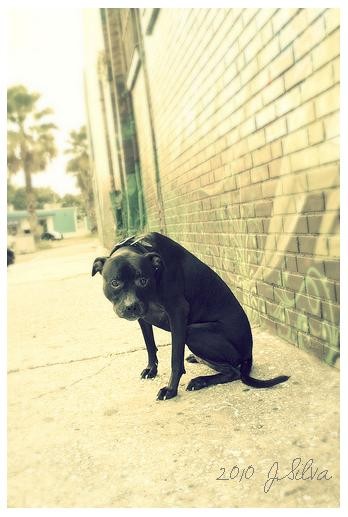
city bully
That's the title of this photograph by artist Jennifer Silva: "City Bully." Doesn't look like much of a thug, does he? Silva has a deft touch at bringing out the sweet side of these powerful, intelligent, and yet vulnerable dogs.
"It's all about spreading as much pitty love as possible," she wrote me. "The reason I started [doing] primarily pit bull photography is purely vain; I love my 2 pit bulls, Marcus and Lucius, and I wanted other people to love them too. Also, when I started my shop pit bull related art was limited, but I am ecstatic to see that it has since taken off and more artists are spreading love."
She says of this particular work that it's one of her favorite dogs posing in one of her favorite spots in her town of Jacksonville, FL. The washed sepia printing gives the image an instant air of time gone by, and when I saw this piece I could not help but think of the many dogs I have passed in my life. They were many sizes, shapes and colors, as dogs are, but most of them had this same ageless look of entreaty. I mean, if there's one thing any dog knows, it's how to say a wordless "Oh, please. . ." Please - give me that sandwich? Please don't hurt me? Please find me a home? Pits ask all those things just like any dog, and that's why I find this piece so appealing.
You're sure to like Jennifer Silva's other pit bull pieces too - visit her Etsy shop to see them.
Sunday, January 16, 2011
lee county clowder shares bull story
He's about eleven feet tall and 16 feet long, and 7,100 pounds. He's the bronze "Charging Bull" in lower Manhattan's Bowling Green Park, and for a few hours very early Christmas morning, he wore a formfitting, cosy pink sweater. The pullover was a gift from NYC artist Olek, whose chosen medium is knit and crocheted textile. She's originally from Poland, and was missing her family at the holiday. Knowing other people out there were missing their loved ones, and as a gift to the city and gesture to better days ahead, she crocheted up a spiffy pink, purple, green and black number and headed off to the park at 2:30 in the AM to fit it on. (Mind you, it was 20 degrees out.) There's a video of this. You should watch. And Olek's site is fun.
Friday, January 14, 2011
a dog is cared for tenderly in a will, 1729
* * *
Our last extract is a remarkable instance of a man's gratitude to his dog for faithful services. It is from the will of Samuel Trevithuan, of the parish of Padstow, in Cornwall, carpenter, dated Nov. 26th, 1729. The will is now in the Registry of the Consistorial Court of the Bishop of Exeter:—
"Item.—I do give unto my dear wife or my daughter, or to whose hands soever he may come, one shilling and sixpence weekly, for the well-treating my old dog, that has been my companion through thick and thin almost these fifteen years. The first time that ever he was observed to bark was when that great eclipse was seen, April 22nd, 1715. I say, I do give one shilling and sixpence a week, during his life, for his well-meating, fire in the winter, and fresh barley-straw now and then, to be put in his old lodging, in the middle cage, in the old kitchen, to be paid out of my chattel estate, and forty shillings a year that I reserved to make me a freeman of the county; desiring and requiring all people and persons whomsoever, not to hurt or kill him that hath been so good a servant of a dog, for sense and tractableness to admiration."
from The world of wonders: a record of things wonderful in nature, science and art (London, Paris & New York: Cassell, Petter, Galpin & Co, 1883) part I p. 39
Wednesday, January 12, 2011
england, 1200's: recommended pets for nuns
Ye shall not possess any beast, my dear sisters, except only a cat. An anchoress that hath cattle appears as Martha was, a better housewife than anchoress; nor can she in any wise be Mary, with peacefulness of heart. For then she must think of the cow's fodder, and of the herdsman's hire, flatter the heyward, defend herself when her cattle is shut up in the pinfold, and moreover pay the damage. Christ knoweth, it is an odious thing when people in the town complain of anchoresses' cattle. If, however, any one must needs have a cow, let her take care that she neither annoy nor harm any one, and that her own thoughts be not fixed thereon. An anchoress ought not to have any thing that draweth her heart outward. Carry ye on no traffic. An anchoress that is a buyer and seller selleth her soul to the chapman of hell.
-- From The nun's rule: being the Ancren riwle modernised by James Morton, The King's Classics under the General Editorship of Professor Gollancz (London: The De La More press, 1905), p. 316.
Monday, January 10, 2011
imagine all those kitties
John Lennon. "Likes: cats."
(And I may add, "Hobby: writing.") You'll learn about Tim the orange cat, whom John rescued from the snowy street; Major and Minor, and guess what colors they were; and see the spirited, freewheeling cat drawings he made which give a fine feel for the cat in its many moods. There's also a brief vignette of cat-enhanced life in the Dakota here at Men and Cats.
Now Good Cats, I have to ask - what about George Harrison and cats?
Saturday, January 08, 2011
on the nature of curiosity
The cat and dog, when taken to a strange place, institute, by scratching and smelling, an inquiry as to the nature of the premises: without being metaphysicians, they settle the question of distinctions and differences, and finally, coil themselves on the hearth-rug and consent to be at home.
But the cat and dog's master and mistress, when taken to a strange place, begin in another way. Their inquiries are all personal. " Who is he ?" " Where does she come from?" "Where do his friends live ?"—till a copious series of questions put the inquirer in possession of many a stranger's personal narrative. But it requires a much longer time to make a curious man and woman settle down on the hearth-rug than suffices for Puss and Ponto.
From MY NEIGHBOURS OVER THE WAY, by "Miss Jewsbury," and reprinted from the British Magazine in the Museum of Foreign Literature, Vol. 17 July-Dec 1830, p 131.
Thursday, January 06, 2011
vintage photo time
Tuesday, January 04, 2011
a kitten and its girl look to the future
Franz von Lenbach (Bavaria, Germany; 1836 - 1904) painted many of the most famed people of his day, in a Realist style favored in Europe at that time. I don't know if this little girl was famous or high born, but I doubt it. Perhaps the cat was. (Kidding.) Isn't it interesting how sketchy the cat's fur and the child's hands are, but it takes you a minute to notice? At first all you see is how well rendered both the faces are, as they stare off to the side with that mix of wonder and apprehension young creatures often have. Though I must say I don't care for the
Sunday, January 02, 2011
italian legend: how the cat was created
* * *
St. Francis de Paula performed so many miracles that the devil was made ill with envy. Once he entered the cell of St. Francis in the shape of a grand nobleman with a box full of heavy gold pieces. "Here, Francis," said he, " take these, don't remain in this miserable hovel, enjoy life; it is strewn with roses, why do you collect all the thorns?" St. Francis, without more ado, raised his hand and made the sign of the cross, whereupon the fine gentleman disappeared amid clouds of sulphur smoke. Another time the devil led lovely damsels, barefooted and lightly clothed, into the cell of the saint, and then queens and empresses of glorious beauty covered with jewels and wrapped in mantles of gold tissue. But St. Francis stood there like a log of wood, and at last made the sign of the cross, when everything disappeared. The devil was furious. "I must find some way to make this stolid fellow lose patience.''
After much thought he rubbed his hands with delight. He created mice, and they multiplied by thousands in the wink of an eye. The cell of St. Francis was filled by them and he tried in vain to drive them out with his hands and feet. But as he drove them out of the door they swarmed in at the window, and when he closed both door and window they crept up through holes in the brick floor or dropped down through cracks in the ceiling. Then they clambered up the saint's tunic, made beds in his straw mattress, played pranks in the provision basket and were generally offensive. At last St. Francis, after reciting a fervent prayer, burst out laughing. The mice were beginning to attack him in thousands, when a beautiful little cat was created in the sleeve of his tunic. So he cried to the mice: "I implore you to stop and go your ways or you will repent it."
The mice answered by pushing their noses against the bare skin of the saint, as though they wanted to pierce through him, so he drew the beautiful little cat out of his sleeve, and it sprang at the mice blessed with such a miraculous hunger that it swallowed two at a time of the big ones, and three or four of the little ones. St. Francis hoped they would have been exterminated, and rushed to stop up a hole in the ceiling (he had already shut the door and the window), but he was not quick enough. A pair of mice managed to escape, and thus we have those tiresome mice all over the world. St. Francis then uttered another prayer, and his beautiful little cat was granted a companion. They multiplied exceedingly, and have always been favorites with devout old ladies because they are a creation of St. Francis.
* * *
Isn't that a delightful tale? I found this legend, written by Antonio de Nino for the London Spectator, copied in the August 1899 Fur Trade Review (I'm not kidding - Vol, 27 p. 443).