About Me

My photo
Oregon, United States
loves: you win if you guessed "pets" and "museums". Also books, art history, travel, British punk, Korean kimchi, bindis, martinis, and other things TBD. I will always make it very clear if a post is sponsored in any way. Drop me a line at thepetmuseum AT gmail.com !
Showing posts with label woodcut. Show all posts

Sunday, May 05, 2019

posada's fat cat dances

www.metmuseum.org Gift of Roberto Berdecio, 1960 (PD)

For Cinco de Mayo I'm bringing you this sprightly wood-engraved scene by Jose Guadalupe Posada.  Here in Mujer bailando con gato (Woman Dancing with a Cat, c. 1900) a dancer steps out in her fine fringed shawl, surrounded by her similarly decked friends.  But why's the cat in a tailcoat?  After doing a little reading on Posada (like here), I think this is his way of lampooning a personage, a fat cat.  You have to admit that cat isn't skinny, and the fancy coat has long been shorthand for identifying bankers, politicos and other possibly-corruptible callings.  Is this poking fun at an official playing at being "man of the people"?  

Tuesday, April 17, 2018

a cat woodcut a day keeps the blues away

images copyright and by kindest permission of the artist
Boston, MA artist Hillary Sprague loves woodcuts.  She comes by this love naturally; as the daughter of a master furniture maker, she grew up watching the beauty of natural materials being shaped in tandem with good craft.  "I find beauty in how their unique properties can influence the direction of your craft- as if you are collaborating together," she writes.  
For 2018 she's decided on an intense and fun engagement with her chosen medium.  She's doing a cat-themed woodcut per day till 2019, and that's freehand. No prep drawing, no tracing, just cutting.  Above is "First Light," and below is "Window Seat."  I'm going to reiterate that - one cat woodcut every day.  Longtime readers know how fond I am of woodcuts, so you know I was thrilled.
Want to keep up with the challenge and see her other work? 
Here's H M S Printmaking on Etsy.
Here's her website.
Enjoy!

Sunday, April 08, 2018

top hat

Takeuchi Seihō [Public domain in Japan], via Wikimedia Commons
Are you looking for a hat or a house, little fellow?  We've seen nihonga painter Takeuchi Seiho at the Museum before, but this 1937 "Mouse and Top Hat" is a perfect snapshot of Seiho's use of Western realism in an unmistakably Japanese way. 

Tuesday, March 06, 2018

a mouse has a snack

Gift of the Estate of Dr. Eleanor Z. Wallace www.brooklynmuseum.org
This woodcut by Mochizuki Gyokusen (Japanese, 1794-1852) shows the simplest of pleasures. "Mouse Eating Pea Pods," ca. 1850. 


Sunday, February 11, 2018

the turtle akbar

  • Gift of G.A. de Graag www.rijkmuseum.nl
Before I do anything else, let me offer you the link to this piece over at the Rijksmuseum, so you can really see and enjoy it.  This is a print (woodcut) by Dutch artist Julie de Graag (1877-1924), immortalizing turtle Akbar, dog Max, and cat...uh, Puss.  ("Poes" in Dutch.)  There is very little in English-language scholarship to date about de Graag, which is a pity, as her woodcuts of animals and nature are devastating in their skill and beauty.  Look:

  • Gift of G.A. de Graag www.rijkmuseum.nl

Three Cats, 1916

  • Gift of M. J.. de Graag www.rijkmuseum.nl
Ferns, 1920
I was able to find an entry on de Graag in the Dictionary of Women Artists (1997).  

Tuesday, December 05, 2017

thomas bewick notes a sagacious dog

see below for attribution
Thomas Bewick (English, 1753-1828) was a naturalist and wood-engraver whose studies and work gained him an excellent reputation as an artist and scholar.  Here's an excerpt from his letters in whch an ancient sheepdog brings him - eventually - just the right model:

* * *
I shall, however, notice an instance, as it happened to occur between my two friends, Mr. Smith, of Woodhall, and Mr. Bailey. The latter, in connection with his report on Cheviot sheep, had given a bad figure of a ram of that breed. This was construed into a design to lessen the character of Mr. Smith's Cheviot sheep, on which, in April, 1798, the latter sent for me to draw and engrave a figure of one of his rams, by way of contrasting it with the figure Mr. Bailey had given. The colour Mr. Smith gave to the business was, not to find fault with Mr. Bailey's figure, but to show hew much he (Mr. Smith) had improved the breed since Mr. Bailey had written his report. Whilst I was at Woodhall, I was struck with the sagacity of a dog belonging to Mr. Smith. The character for sagacity of the Shepherd's Dog was well-known to me, but this instance of it was exemplified before my own eyes. Mr. Smith wished to have a particular ram brought out from amongst the flock, for the purpose of my seeing it. Before we set out, he observed to the shepherd, that he thought the old dog (he was grey-headed and almost blind) would do well enough for what he wanted with him. Before we reached the down, where the flock was feeding, I observed that Mr. Smith was talking to the dog before he ordered him off on his errand; and, while we were conversing on some indifferent subject, the dog brought a ram before us. Mr. Smith found a deal of fault with the dog, saying, Did I not order you so and so? and he scolded him for bringing a wrong sheep, and then, after fresh directions, set him off again to bring the one he wished me to see. We then returned home, and shortly after our arrival there, the dog brought the very ram wanted, along with a few other sheep, into the fold, where I took a drawing of him.
* * *

From Bewick, Thomas, 1753-1828. A Memoir of Thomas Bewick. Newcastle-on-Tyne: Printed by Robert Ward for Jane Bewick , 1862. 182-3.

The illustration: By Thomas Bewick - http://www.metmuseum.org/art/collection/search/345995This file was donated to Wikimedia Commons by as part of a project by the Metropolitan Museum of Art. CC0, https://commons.wikimedia.org/w/index.php?curid=60859319

Monday, May 15, 2017

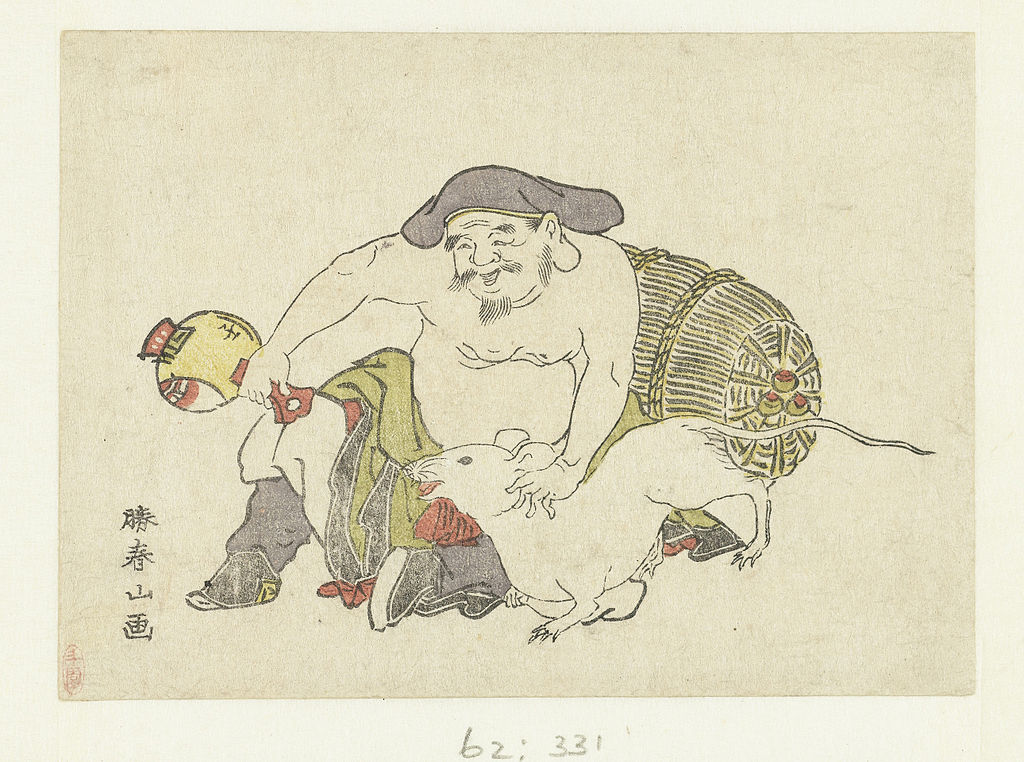
wealth rat

Katsukawa Shunzan [Public domain, Public domain or CC0], via Wikimedia Commons
Here we see Daikoku. the Japanese god of wealth, with his magic hammer (the round-headed yellow item in his fist) and his white rat.  Rats are considered industrious creatures in Japanese lore, and industry brings reward - what better sidekick for a god of wealth?  This jolly image for a back-to-work Monday is by the artist Katsukawa Shunzan (active 1782-98).  Best known for portraits of actors, he took the time to make this lucky charm of a woodcut, and I hope it brings you all good fortune this week.

Friday, May 12, 2017

pompey who?

(PD) courtesy hathitrust
I snipped this curious old nursery rhyme and its illustration from an 1840 children's book.  Who's Pompey and why does he need to say anything?

 -- Rusher, J. Golby. (1840). Nursery poems: from the ancient and modern poets. Banbury: Printed by J.G. Rusher.

Tuesday, March 07, 2017

a wolfhound's horizon

© Trustees of the British Museum (CC BY-NC-SA 4.0) 
Phyllis Gardner (British, 1890-1939) was the daughter of an archaeologist, the secret lover of the poet Rupert Brooke, an illustrator and printmaker trained at the Slade School of Art, and from 1920 on a well-regarded breeder of Irish wolfhounds.  Her "Head of a Dog," above, signed in the Greek version of her name, dates roughly from 1913-26 and shows Gardner's harmonious yet muscular approach to line.  Some of that is what you get with woodcuts, as it lends itself to strong images, but I see an intense grace (and independence) here.  You should be able to get a peek at more of her work here in this search I made at the British Museum.
Here's a footnote.  Phyllis Gardner was buried in an unmarked grave; the Rupert Brooke Society decided to do something about that.  Page on that - with photos of Phyllis and her wolfhounds - here.

Thursday, March 02, 2017

a cat threatening goldfish

Gift of Mrs. John D. Rockefeller, Jr., 1946 philamuseum.org
That's a brave cat.  I wouldn't take on those fish - they look like they mean business.
This is Utagawa Kuniyoshi (1797-1861) with one image from his 1849 woodcut series "A Set of Goldfish" (see more of them here).  This one is called "A Cat Threatening Goldfish, or Ghost Stories (Hyaku monogatari)," and is based on a fascinating ghost story game that originated in Edo-period Japan.
The game itself is called Hyakumonogatari.  In essence it involves a number of players lighting 100 candles, then each person tells a scary story, dousing one candle at the end of their tale.  When all the candles were out, some frightening spirit would be waiting.  So who was brave enough to blow out the final candle?  You can learn more about the game (and find some Japanese ghost stories, or kaidan) at this excellent site.    I haven't been able to find the story behind this image, though.  Let me know if you do!

Thursday, August 04, 2016

just a bird on a vine

http://hdl.handle.net/10934/RM0001.COLLECT.46008  image courtesy the rijksmuseum (PD)
Here's Utagawa Hiroshige, the master known for the "100 Views of Edo" of 1848 on, with a look at a smaller world entirely: a woodcut dated round 1833-7, known at the Rijksmuseum as "Vogel en blauwe winde" (Bird on a blue bindweed).  Though known for his landscapes, Hiroshige was also lauded for his birds and flowers, and you see why.  This gray fellow has a typically alert face, but with a comic quirk to his beak, an interrogating look:  what, buddy?  I also love the smooth oval of his body.  So much bird, so little gesture to create him.