About Me

My photo
Oregon, United States
loves: you win if you guessed "pets" and "museums". Also books, art history, travel, British punk, Korean kimchi, bindis, martinis, and other things TBD. I will always make it very clear if a post is sponsored in any way. Drop me a line at thepetmuseum AT gmail.com !
Showing posts with label renaissance. Show all posts

Tuesday, April 04, 2017

blessed is he who has a pet sloth


Joris Hoefnagel (Flemish / Hungarian, 1542 - 1600), and Georg Bocskay (Hungarian, died 1575)
A Sloth, 1561 - 1562; illumination added 1591 - 1596, Watercolors, gold and silver paint, 
and ink on parchment
Leaf: 16.6 x 12.4 cm (6 9/16 x 4 7/8 in.)
The J. Paul Getty Museum, Los Angeles

Or a tree kangaroo?  1500s Europe was mostly unclear on the difference, though the Hapsburg royal family in Vienna and elsewhere had menageries famed for their variety.  This gorgeous image from the Getty is a mashup: as the object page explains, the words on their black-tinted parchment existed first, spelling out part of the Sermon on the Mount.  Thirty years later around 1591-6 Joris Hoefnagel added the twig-munching creature in his fancy pavilion. 

Thursday, December 29, 2016

squirrel thoughts


http://hdl.handle.net/10934/RM0001.COLLECT.5948 courtesy the rijksmuseum (PD)

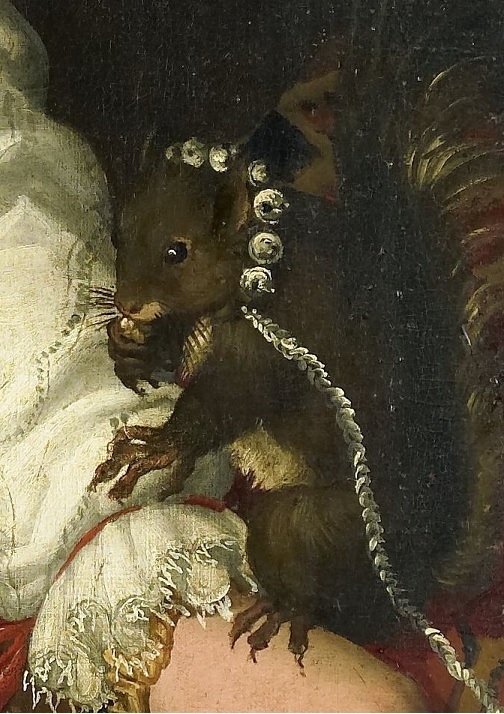
The winter chill outside brings one particular squirrel to our bird feeders.  He must do quite well leeching off our winged visitors, as he's fat, though still able to outdistance the dog.  Off he goes, bouncing across the fencetops and leaving me with a yen to look up some squirrels of the past.  Here's a jewel I'd never seen before, from the Rijksmuseum: Francesco Montemezzano's "Portrait of a woman with a squirrel," c. 1565-75.  Can't see the squirrel very well, right?  Here's a squirrel-hance:


Look at the little belled collar.  Must have driven the little guy to distraction. (See how I didn't say "driven him nuts"?  I found this piece in an excellent list of squirrels in Medieval and Renaissance art, here.)
Montemezzano (Italian, c. 1540-1602) seems to have been a follower of Veronese's style; Veronese was known for the brilliance of his color and elegant portrayal of his sitters.