 |
| Unknown artist Pin with a Finial Shaped as a Dove Sitting on Pomegranates, 525–400 B.C., Gold 7.7 × 0.8 × 0.5 cm (3 1/16 × 5/16 × 3/16 in.), 96.AM.256 Gift of Barbara and Lawrence Fleischman www.getty.edu |

About Me

- curator
- Oregon, United States
- loves: you win if you guessed "pets" and "museums". Also books, art history, travel, British punk, Korean kimchi, bindis, martinis, and other things TBD. I will always make it very clear if a post is sponsored in any way. Drop me a line at thepetmuseum AT gmail.com !
Showing posts with label italy. Show all posts
Showing posts with label italy. Show all posts
Monday, December 03, 2018
a dove in gold

Tuesday, July 31, 2018
handy handle dog
 |
| Unknown Lid, 5th century B.C., Bronze 12.5 × 22.6 cm (4 15/16 × 8 7/8 in.) The J. Paul Getty Museum, Los Angeles |
Saturday, April 28, 2018
"a dog that stinks, come on, come on"
 |
| thanks british library flickr (PD) |
Ogni tristo cane abbaia da casa sua -- Every sad dog barks from his house
A cane che puzza, dagli, dagli -- A dog that stinks, come on, come on (Idiom, and I have no clue -- curator)
Canini, gattini e figli di contadini, son belli quando son piccini -- Puppies, kittens and children of peasants are beautiful when they are little ones
A cani magri, mosche ingorde -- Lean dogs attract greedy flies
Porta rispetto al cane per amor del padrone - Respect the dog for the sake of its master
Un cane arrabbiato corre soltanto nove giorni -- An angry dog runs only nine days
(BUT:) Niun cane arrabbiato corre sett'anni - An angry dog runs seven years (I wonder which? - curator)
Al cane fu data la coda perche scodinzoli -- The dog was given its tail to wag it
- Strafforello, Gustavo, 1820-1903. La Sapienza Del Mondo: Ovvero, Dizionario Universale Dei Proverbi Di Tutti I Popoli, Raccolti, Tradotti, Comparati, E Commentati Da Gustavo Strafforello, Con L'aggiunta Di Aneddoti, Racconti, Fatterelli, E Di Illustrazioni Storiche, Morali, Scientifiche, Filologiche, Ecc. Torino: A. F. Negro, 1883. vol. 1. 229-33.
Friday, April 27, 2018
a standing dog c 1585
 |
|
Saturday, February 10, 2018
another little spaniel, 1560s
 |
Gift of Edith Neuman de Végvár, in honor of her husband, Charles Neuman de Végvár, 1963. www.metmuseum.org |
Monday, April 24, 2017
good morning
 |
Fletcher Fund, 1929 www.metmuseum.org |
Here is an article on Etruscan bird-askoi from the Penn Museum, and another on Etruscan pottery overall from the Ancient History encyclopedia online.
Thursday, December 29, 2016
squirrel thoughts

http://hdl.handle.net/10934/RM0001.COLLECT.5948 courtesy the rijksmuseum (PD)
The winter chill outside brings one particular squirrel to our bird feeders. He must do quite well leeching off our winged visitors, as he's fat, though still able to outdistance the dog. Off he goes, bouncing across the fencetops and leaving me with a yen to look up some squirrels of the past. Here's a jewel I'd never seen before, from the Rijksmuseum: Francesco Montemezzano's "Portrait of a woman with a squirrel," c. 1565-75. Can't see the squirrel very well, right? Here's a squirrel-hance:
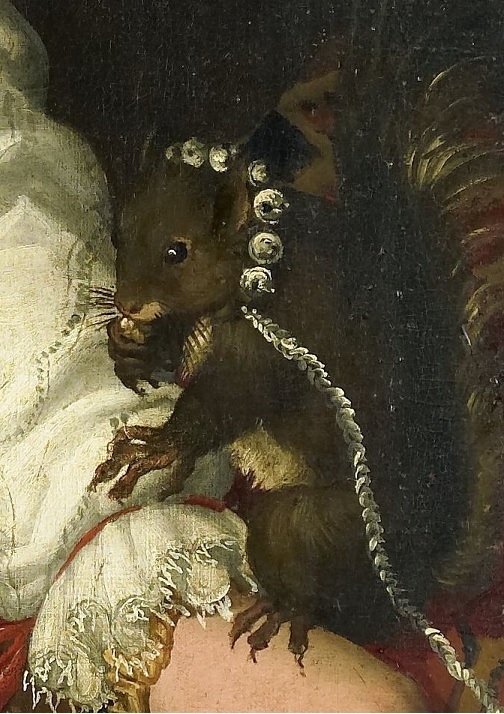
Look at the little belled collar. Must have driven the little guy to distraction. (See how I didn't say "driven him nuts"? I found this piece in an excellent list of squirrels in Medieval and Renaissance art, here.)
Montemezzano (Italian, c. 1540-1602) seems to have been a follower of Veronese's style; Veronese was known for the brilliance of his color and elegant portrayal of his sitters.
Sunday, July 03, 2016
glorious plumage
 |
| courtesy wikimedia commons (PD) |
Subscribe to:
Posts (Atom)